Several types of solar cells have been developed with the aims of reducing costs and improving efficiencies.
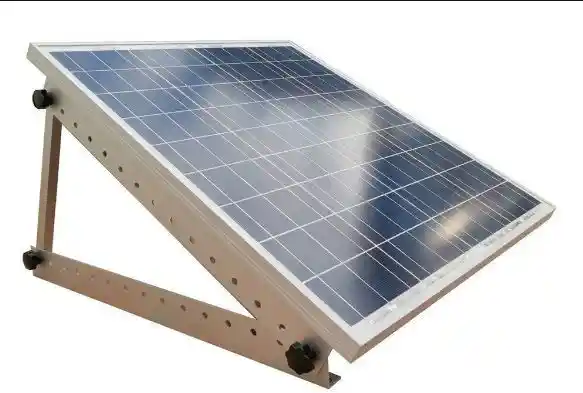
Benefiting from the manufacturing experience of the semiconductor industry, crystalline silicon is the leading solar cell material, though still relatively expensive. Monocrystalline cells are cut from single crystals of high purity electronics grade silicon. These cells are about 25 percent efficient at best. Using the easier to manufacture polycrystalline silicon cut from from a block of crystals or less pure, so called "solar grade" silicon, efficiencies may be only about 15% or 16% due to the effect of grain boundaries or impurities but they cost a fraction of single crystal electronics grade cells.
Amorphous Silicon has been employed for many years in the manufacture the solar cells used for powering electronic calculators and watches and promises the possibility of low cost, higher power cells. Amorphous material appears like a solid but has no regular crystal lattice structure. Glass is an example of such materials. The presence of controlled quantities of certain "impurity" elements such as hydrogen and the random crystal lattice formation actually enhance the otherwise very low conversion efficiency. Typical cell efficiencies range from 5% to 10%.
Manufacturing yield is still a problem and the cells suffer from degradation when exposed to the sun.
Thin film cells are made by depositing the active photovoltaic material, such as amorphous silicon or other semiconductor onto a glass or other substrate together with the necessary current collecting contacts. The cell construction is much less costly than using semiconductor wafers and the manufacturing process is also simpler as well as being suitable for making cells with a much larger area and hence current carrying capability. Efficiencies of 11% to 14% have been achieved with this construction.
PV systems on flexible polymer substrates have also been made using Copper Indium Gallium Selenide (CIGS) active material with efficiencies of 10%.
Intensive research is being carried out by various teams on the use of organic semiconductors in the construction of PV cells. Devices can be fabricated by means of a printing process from single or double layer organic polymer films sandwiched between a pair of electrodes. Manufacturing does not involve the high energy consumption associated with crystalline semi conductors and brings the possibility of high volume, low cost products printed onto flexible films. Currently, conversion efficiencies are rather low at around 12% but this is expected to improve.


Posted By :
Mahesh Nigam
(Scientist)
2019-09-27 17:13
See Author's other Published Topics
Peoples